Would You Move Your Shift Key?

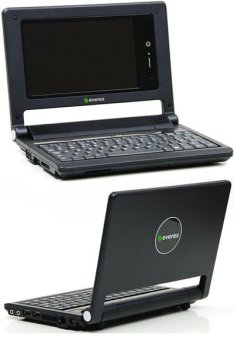
One of the things difficult to adjust with on the Asus Eee PC is the location of the right shift key. Sure, the keyboard is small, but pretty soon an Eee user would be able to adjust to the size. But the location of the shift key might prove to be difficult because the up arrow is wedged in between the ? key and the right shift key, whereas in regular keyboards, the shift is right next to the ? key.
Most of the time this would result in mistyping because you would accidentally hit the up arrow instead of the shift key, and your typed characters would suddenly be in a higher line (or another text field, altogether). Believe me, I’ve messed up a handful of documents and blog post drafts this way.
Eeeuser has a solution, which involves remapping the keys such that the shift and up buttons are swapped. This would also swap the down button with the right button. This way the arrow keys would be in a reverse-L position (reminiscent of old Toshiba notebooks).
This way you’re less prone to hitting the up arrow accidentally while typing. Then again, your navigating experience might be adversely affected (up, down, left, right).
It’s a tradeoff, and it depends which is more important to you, or if you can easily adjust to having the up arrow wedged in between.
Oh, and Eeeuser even suggests that you can swap the keys themselves! It’s possible and doable (done here!) but I advise you to be careful.
Can You Middle-Click on the Asus Eee?
The answer is yes. From the looks of the one-button clicker on the touchpad, it seems at first that a simulated middle-click is impossible. That is, clicking both the left and right buttons. However, you can indeed click both left and right clickers. Just click as far away from the middle as you can.
You’d have to be careful, though, not to press too hard, as you might break your clicker.
Middle-click is useful in Firefox for one-click closing of tabs or for opening links in new tabs (without having to press the Ctrl key). It’s also useful when copying and pasting across windows, especially when using the Linux terminal/console.
Update
You can also middle-click by tapping two points on the touchpad. Yes, much like the MacBook’s trackpad, the Asus Eee’s touchpad supports multi-touch. So this means you can tap with two fingers, and that action will be read (by default) as a middle-click.
First time!
It’s my first time to bring my Asus Eee PC out of the house. I went for a quick cup of coffee at a nearby cafe with the wife and kids. So it’s a field test so to speak.
I got a couple of curious glances from other patrons and passers by. Looks like the Galaxy black Asus Eee PC has that wow factor!
Can Solid State Drives Really Help Extend Battery Life?
Extending battery life has been the holy grail of mobile computing. But can solid state hard drives really help?
Recently, the trend is going towards solid-state storage. This means drives that have no moving parts. Most popular of these is flash memory. They’re cheap, durable, and can hold data even without power (unlike volatile RAM, which loses data when power is off). Since flash memory can allegedly reduce consumption caused by spinning hard drives, some manufacturers have switched to using solid state drives for their mobile computers. There are also flash-based hard drives meant for notebook computers that users can replace their existing drives with.
The Asus Eee MyPC sports a flash-based hard drive, instead of a conventional spinning one. One factor may be price (since a small flash drive is cheaper than a micro-sized hard drive with spinning parts). One may be power consumption.
However, a simple test done by ZDnet blogger Robin Harris has rendered results that may run counter to the argument that a solid-state drive helps extend batter life.
The maximum power difference between a flash drive and a 2.5″ disk is 3 watts. If you average about 3 hours battery life, a flash drive would save at most 9 watt hours (wh). That’s 29 minutes with a 55 wh battery. Less than 20 if it isn’t seeking constantly - and less than 10 minutes if the drive spends half its time in standby mode.
The biggest power sink in my notebook is the “everything else” that stays on when nothing is happening - 13 watts. Next is the CPU when it is busy. Then the display if you keep it above minimum brightness, the DVD/CD player and finally, just above Wi-Fi, a busy disk.
Flash drives have a real advantage in shock resistance over disks. But the performance is about the same as a disk, the power savings minimal and the cost disadvantage huge. They make the most sense for premium ultra-light notebooks with low power CPUs and small screens as well as hand-held devices.
I guess I must add that speed is one of the advantages of flash-based storage over a disc-based one. Still, I’d like to get more juice out of my Eee’s battery. Maybe when Asus releases a Pentium-M based Eee that would be better at saving power.
Is the Asus Eee Underpowered?
There are a lot of drawbacks when you choose a small device over a conventional-sized one. Well, actually you do have an option to get yourself a small but power-packed device, such as Fujitsu-branded subnotebooks. However, there is a big price to pay. So for sub-$400 prices, I would say that the Asus Eee is worth it.
Here’s a good explanation why the Eee makes for a great subnotebook, even with its limitations.
As long time laptop users, our opinion is the primary strength of the EEE PC laptop is as a 2nd unit. A mobile unit for a desktop user. A second more portable unit for a laptop user. The size and weight of this laptop allows you to put it in any bag and not feel the weight. The Price does not make the owner guilty when the item is lost, dropped or damaged. The EEE PC is more economical than the latest Nokia Communicator, yet it is easier to use. The EEE PC in our opinion matches the portability of the Blackberry, yet is easier to use because of the keyboard layout. The EEE PC is ideal for those who want something small and Wi-Fi enabled.
The EEE PC is certainly a very innovative unit. The Eee PC’s “earned” reputation as the Fastest Selling PC in the World comes from the great user expectation as a simple and portable device focused on providing users with the most comprehensive Internet applications based on three Es: Easy to learn, work, play; Excellent Internet experience and Excellent on-the-Go.
These are in answer to some of these pressing questions relevant to the Eee PC:
1. Processor: This unit must be slow, it comes with a Celeron-M processor.
2. Operating System: Can I load Windows XP on this laptop?
3. Hard drive:
a. Is 4Gb of Harddrive Enough?
b. Can I upgrade the Harddrive?
4. RAM: Should I increase RAM to 1Gb?
5. Can I watch DvD On this laptop?
6. Can I use the EEE PC to surf the net and email?
7. Is the keyboard easy to use?
8. How long is the Battery life?
9. Can I connect the EEE PC to a projector for presentations?
10. Can I use a mouse?
11. Is the EEE PC durable? It looks like a V-Tech Toy.
12. Can this laptop replace my desktop and existing laptop?
The CoolToyz article has great responses to each of these!